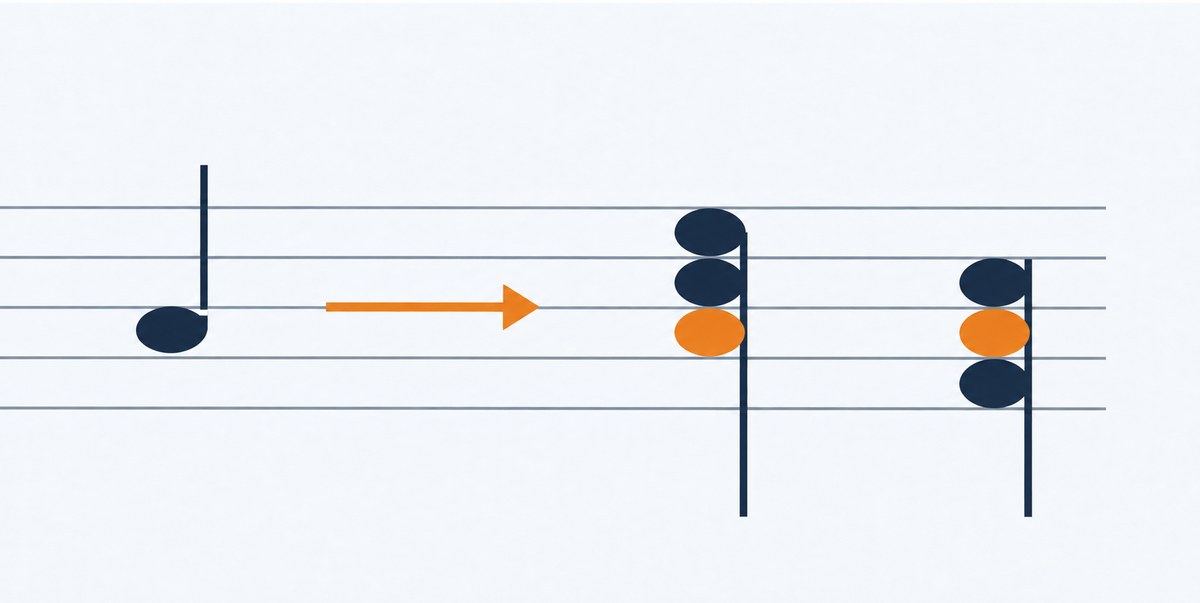
Imagine playing the same melody twice. The notes stay the same, but the harmony changes. One version may feel calm and settled. Another may feel more tense or mysterious, even if the notes are the same.
Different notes adding upon the same note, like going from E to E and B to E,G,B changes the feel.
That is the power of harmony.
What Is Harmony?
Harmony happens when different notes sound together. A common type of harmony is a chord.
For example:
C major: C – E – G
Another example is:
A minor: A – C – E
Robert Hutchinson, Distinguished Professor of Music at the University of Puget Sound, teaches music theory and composition and wrote Music Theory for the 21st-Century Classroom. He explains how chords can have different jobs in music. The tonic often feels like “home,” while the dominant can make the music feel like it needs to keep moving. When the tonic returns, the music can feel settled again.
Andrea Stolpe, a multiplatinum songwriter and Berklee Online instructor, also explains that harmony does not need to be complicated. Sometimes changing just one chord can give a section a different mood or create contrast.
So harmony can help music feel settled, tense, bright, mysterious, or unfinished.
A Simple Example of Harmony
To understand harmony, let’s look at an example.
Wolfgang Amadeus Mozart wrote Eine kleine Nachtmusik, K. 525. In the first movement, Mozart begins in G major, the home key. The music later moves to D major, the dominant key, before eventually returning home to G major. W. W. Norton’s analysis of the movement identifies the opening theme in the tonic and the transition into the dominant.
You can think of it simply as: G major → D major → G major
This is similar to the idea Professor Hutchinson describes. G major feels like home. D major takes the music away from home. When G major returns, the music feels settled again.
So harmony can help music feel as if it is going on a journey. In this case, a round-journey.
Beethoven: Creating Tension and Returning Home
Another simple example comes from Ludwig van Beethoven’s Für Elise.
Hutchinson analyzes the harmony in the opening section of Für Elise. The music is in A minor and moves between the home chord and a chord that creates tension before returning home.
You can think of it simply as: A minor → tension → A minor
At first, the music feels at home. Then the harmony creates a feeling that something needs to happen next. When A minor returns, the music feels more settled again.
Hutchinson also shows that the first musical phrase ends less strongly, almost like a question, while the next phrase gives a stronger ending, more like an answer.
This shows another way composers can use harmony: not only to change mood, but also to create questions, answers, tension, and resolution.
Harmony Adds Another Layer
Young composers often begin by focusing on melody. Harmony gives that melody another layer.
It can make music feel settled or unfinished. It can create tension, change the mood, or help the music move from one place to another.
As Andrea Stolpe explains, harmony does not always have to be complicated. Even a small chord change can make a difference.
The melody gives us something to follow.
Harmony helps shape how that melody feels along the way.
References
- Hutchinson, R. Music Theory for the 21st-Century Classroom. University of Puget Sound.
- Stolpe, A. (2015). “Harmonic Progressions for Songwriters.” Berklee Online: Take Note.
- Internationale Stiftung Mozarteum. “Eine kleine Nachtmusik, K. 525.” Köchel Catalogue Online.
- W. W. Norton. “Mozart: Eine kleine Nachtmusik, Movement I.” Interactive Listening Guide.