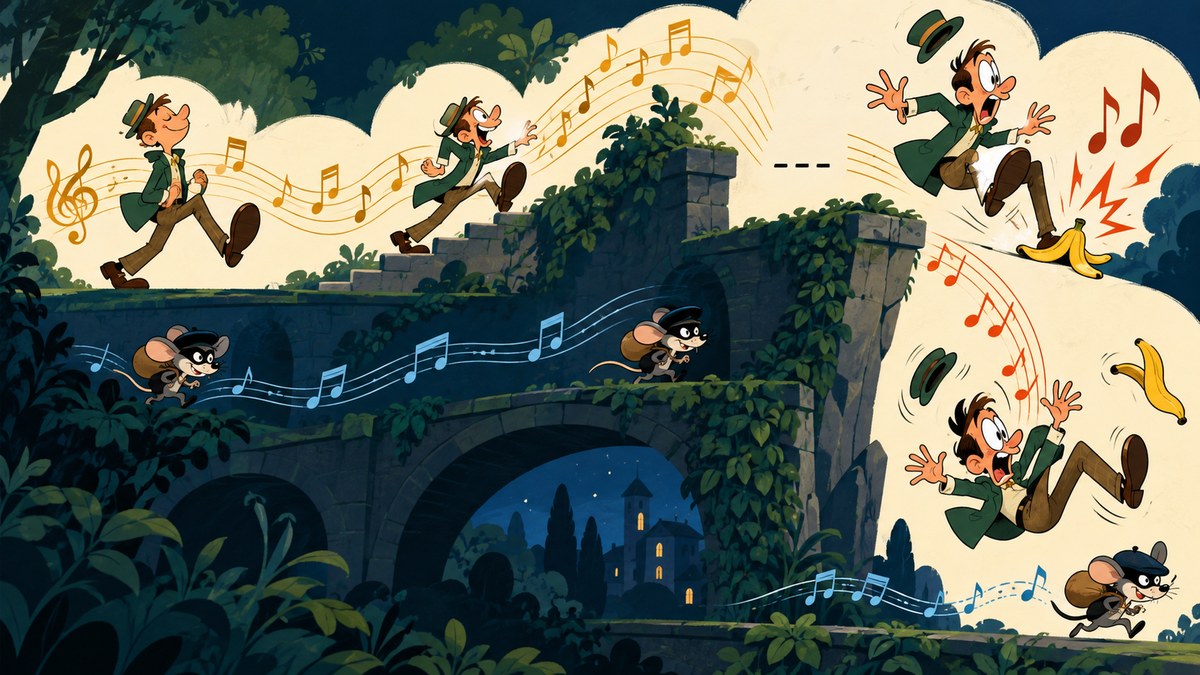
Imagine a cartoon character sneaking across a room. Each step has a tiny musical sound. Then the character slips, and the melody suddenly drops too.
The picture may already be funny, but the music adds another layer to the joke. Composers have used music this way since the early days of animation.
When Music Follows the Action
There is a name for music that closely matches what happens on screen: Mickey Mousing.
Mickey Mousing means matching a specific action on screen with a musical sound or musical movement. The music almost copies what the character is doing.
If a character walks up a staircase, the notes might climb higher. If the character falls, the melody might drop quickly. A jump, hit, or sudden surprise can be marked with one sharp sound.
The name comes from the close connection between music and movement in early animated cartoons, especially those associated with Mickey Mouse. Over time, the term became a general name for this style of scoring.
It can make the music feel almost like part of the animation itself.
Timing Makes the Joke Work
Comedy often depends on exactly when something happens. A musical accent placed at the right moment can make a fall, turn, or surprised expression much funnier.
Carl Stalling (1891–1972, United States), a composer and arranger best known for his work in animated cartoons, became well known for this kind of precise cartoon scoring. He worked on early Disney animation and later wrote music for Warner Bros. cartoons. His scores could change style, tempo, and mood very quickly to match what was happening on screen.
A peaceful scene could suddenly become wild and chaotic within seconds. That quick musical reaction helped give cartoons their fast, unpredictable energy.
High Notes, Low Notes, and Funny Sounds
Pitch can help shape how a character feels. A small, quick character might be paired with light sounds in a high register. A large character might enter with lower, heavier sounds. But composers can also do the opposite. A huge character entering to a tiny, delicate melody can be funny because the sound does not match what we expect. Sometimes the joke comes from that contrast.
Silence Can Be Funny Too
Music does not have to fill every second. A pause can sometimes make a scene funnier than another note would. Imagine a character running toward the edge of a cliff. The music is fast and busy. Then it stops. The character looks down. Only after that pause comes the fall.
The silence gives the audience a moment to understand what is about to happen. That short delay can make the punchline stronger.
Music Can Give a Character a Personality
Cartoon characters can also have their own musical identity.
A sneaky character might be connected with a quiet, unusual rhythm. A hero might have a bold theme. A clumsy character might have music with awkward pauses or unexpected changes.
When a musical idea returns with the same character, viewers begin to recognize the connection.
That idea can also change with the story. A theme might become slower during a sad moment, faster during a chase, or softer when the character is nervous.
The melody remains familiar, but its personality changes with the scene.
Listen to the Cartoon
Cartoon music often works so well that we barely notice it.
But listen carefully, and you may hear the score reacting to footsteps, expressions, surprises, pauses, and changes in mood.
Music can make an action feel lighter, heavier, stranger, or more dramatic.
It can also prepare us for a joke before we even know what is coming.
The next time you watch a cartoon, try listening for a few moments without focusing only on the picture.
You may discover that some of the funniest parts are happening in the soundtrack.
References
- Library of Congress. Molto Animato! Music and Animation. An exhibition about the history of music in animation, including synchronization of music with action and the technique known as “Mickey Mousing.”
- Mansky, Jackie. (2019). “Before the ‘Baby Shark’ Song Made the Hot 100, ‘Silly Symphonies’ Were All the Rage.” Smithsonian Magazine, January 17, 2019.