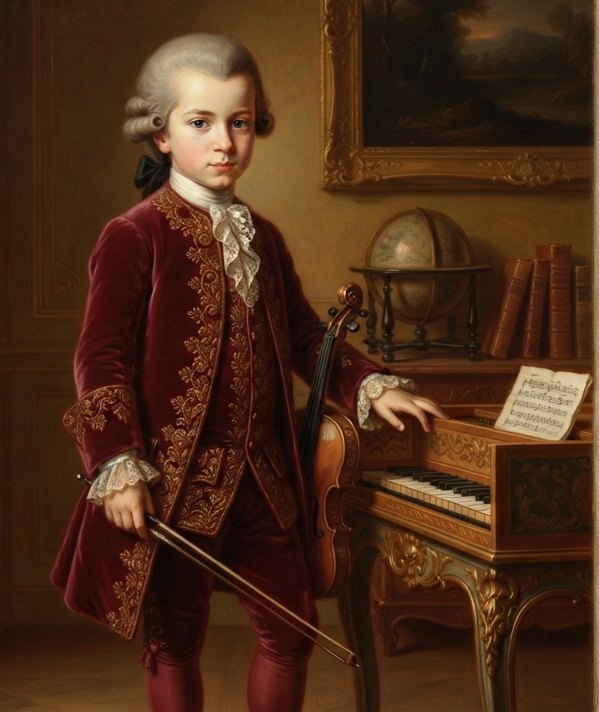
Music is more than just hearing sounds. It is the art of turning an idea, feeling, or pattern into something that others can experience.
Many of history's best known composers began experimenting with music when they were young. Some created melodies before they could fully write musical notation. Others began with short piano pieces and gradually worked their way toward larger compositions, including quartets and even operas.
What connected them was not a single formula for success. It was curiosity, imagination, and the desire to create.
And there is something important to remember before we begin: you do not have to be at a certain age to start composing. These stories simply show that musical creativity can begin at any age.
Now is better than later.
Camille Saint-Saëns, around age 3
French composer, pianist, and organist Camille Saint-Saëns (1835 to 1921, France) showed extraordinary musical curiosity from a very early age.
He composed his first dated piano piece at age three and a half. His great aunt and first piano teacher, Charlotte Masson, encouraged his early musical development and helped guide his first experiences with the piano.
Around age five, Saint-Saëns was already performing publicly, including accompanying violinist Antoine Bessems in a Beethoven violin sonata.
His story is a reminder that a composition does not have to begin as something large or complicated. Sometimes it begins simply as a musical idea waiting to be explored.
Wolfgang Amadeus Mozart, age 5
Wolfgang Amadeus Mozart (1756 to 1791, Austria) is probably history's most famous example of a child composer.
Mozart began experimenting with short musical pieces when he was very young. Before he had fully developed the ability to write musical notation, he played with his musical ideas for his father, Leopold Mozart, who helped write them down. Mozart's earliest known compositions date from 1761, when he was five years old. Among them is Andante in C Major, K. 1a, one of the first pieces recorded in the notebook originally created for his sister Nannerl.
Mozart's childhood shows something encouraging for beginners: you do not have to master every rule of notation before you can begin having musical ideas.
The idea can come first. The technical skills can follow.
Sergei Prokofiev, age 5
Russian composer and pianist Sergei Prokofiev (1891 to 1953, Russia) began experimenting with composition even earlier in childhood, writing his first piano piece at about age five.
At age nine, after seeing Gounod's Faust in Moscow, he composed his first opera, The Giant, which was performed for a small family audience.
Writing an opera requires more than creating melodies. It involves characters, storytelling, dramatic structure, and connecting music to a larger narrative. Prokofiev created both the music and the story for the work.
Most young composers do not need to begin with an opera, but his example demonstrates how far a simple musical idea can grow when imagination is allowed to take over.
Frédéric Chopin, age 7
Polish composer and virtuoso pianist Frédéric Chopin (1810 to 1849, Poland) grew up surrounded by music.
His earliest musical instruction came from his family, and he began regular piano lessons with Wojciech Żywny at age six. By age seven, Chopin had already composed polonaises in G minor and B flat major. His Polonaise in G Minor became his first published composition in 1817.
His remarkable musical talent was recognized very early, and contemporary accounts compared his childhood gifts with those of Mozart.
Chopin would eventually become one of the most influential composers for piano, an instrument that remained at the center of his musical voice throughout his life.
Alma Mahler, age 9
Alma Mahler (1879 to 1964, Austria) was a pianist and composer who began writing music at around age nine. She later studied composition formally and focused especially on writing songs for voice and piano.
Songwriting combines two powerful forms of expression: words and music. A composer must think not only about melody and harmony, but also about how music can strengthen the meaning and emotion of a text.
Her early interest in songs is another example of how young composers can begin through whatever type of music attracts them most.
Clara Schumann, around ages 9 to 10
Clara Schumann (1819 to 1896, Germany) grew up in a highly musical household. Her father, Friedrich Wieck, was a prominent piano teacher, while her mother, Marianne Wieck, was a professional singer and pianist. Clara began formal musical training at age five and started composing around age nine.
Among her earliest works were the Quatre Polonaises, Op. 1, composed between 1828 and 1830 and published in 1831.
She later became one of the most celebrated pianists of the nineteenth century while continuing to compose.
Her story also shows how closely performance and composition can support one another. Learning how music feels under your fingers can influence the music you choose to create.
Felix and Fanny Mendelssohn, around ages 10 to 14
The Mendelssohn household became a remarkable environment for musical experimentation.
Felix Mendelssohn (1809 to 1847, Germany) showed exceptional musical ability from an early age. He began composition lessons at age ten and soon started writing extensively. His early works included piano pieces, songs, chamber music, and larger compositions. His family also organized private Sunday concerts at home, giving Felix opportunities to hear music performed and develop his skills as a young composer.
His older sister, Fanny Mendelssohn (1805 to 1847, Germany), was also an accomplished pianist and composer. She studied composition alongside Felix with Carl Friedrich Zelter. Her first surviving composition, Ihr Töne schwingt euch fröhlich, was written at age fourteen as a birthday gift for her father.
Both siblings benefited from a home filled with music, where their works could be heard, discussed, and developed.
Their childhood demonstrates an important part of composing: music grows when it can be written, heard, reconsidered, and revised.
Ludwig van Beethoven, age 11
Before becoming one of the most influential composers in Western music, Ludwig van Beethoven (1770 to 1827, Germany) began developing his skills as a composer while still a child.
At age eleven, Beethoven published his first composition, Nine Variations on a March by Ernst Christoph Dressler, WoO 63. He wrote the piece while studying with his teacher Christian Gottlob Neefe, who helped arrange its publication in 1782.
The work takes an existing march melody and transforms it through a series of nine variations.
Variation is still one of the most useful tools a young composer can explore today. Begin with one musical idea and ask: what happens if I change the rhythm? The harmony? The register? The mood?
One idea can generate an entire piece.
Benjamin Britten, age 14
Benjamin Britten (1913 to 1976, United Kingdom) was a pianist and violist who grew up in a highly musical household. His mother, an amateur singer and pianist, especially encouraged his early attempts at composition.
Britten began composing extensively while still very young. At age fourteen, shortly after beginning lessons with composer Frank Bridge, he wrote his String Quartet in F Major in 1928.
What began as childhood experimentation eventually developed into a lifelong career as one of Britain's major twentieth century composers.
What Can We Learn From Them?
These composers had very different beginnings.
Some grew up in highly musical families. Some had access to exceptional teachers. Some started composing as very young children, while others developed more substantial works during their teenage years.
Their stories should not make you think that there is a deadline for becoming a composer.
There isn't.
What they do show is that composition often begins with something very small: a melody, a rhythm, a pattern, a question, or simply the thought, "What would happen if I tried this?"
Today, young composers have tools that Mozart, Chopin, and Beethoven could never have imagined. You can write music digitally, hear your ideas immediately, revise them, record them, and share them with people around the world.
You do not need to begin with an opera. You do not need to write a symphony. You do not even need to know exactly what your piece will become.
You just need somewhere to start.
Maybe that beginning is only three notes. What happens next is up to you.
Ready to bring your first melody to life? Start composing at PieceFoundry.
References
- Stegemann, M. (1991). Camille Saint-Saëns and the French Solo Concerto from 1850 to 1920. Amadeus Press. ISBN 9780931340352.
- Solomon, M. (2005). Mozart: A Life. HarperCollins. ISBN 9780060883447.
- Morrison, S. (2009). The People's Artist: Prokofiev's Soviet Years. Oxford University Press. ISBN 9780195181678.
- Zamoyski, A. (2010). Chopin: Prince of the Romantics. HarperPress. ISBN 9780007341849.
- Carr, J. (1997). Mahler: A Biography. The Overlook Press. ISBN 9780879518028.
- Reich, S. (2005). Clara Schumann: Piano Virtuoso. Clarion Books. ISBN 9780618551606.
- Mercer-Taylor, P. (2000). The Life of Mendelssohn. Cambridge University Press. ISBN 9780521630252.
- Todd, R. L. (2005). Mendelssohn: A Life in Music. Oxford University Press. ISBN 9780195179880.
- Todd, R. L. (2014). Fanny Hensel: The Other Mendelssohn. Oxford University Press. ISBN 9780199366392.
- Swafford, J. (2014). Beethoven: Anguish and Triumph. Houghton Mifflin Harcourt. ISBN 9780618054749.
- Lockwood, L. (2003). Beethoven: The Music and the Life. W. W. Norton & Company. ISBN 9780393050813.
- Lenson, B. (2025, February 25). Composer Profile: Benjamin Britten. Classical Archives.