How can numbers and patterns help create music?
Music is a hidden arithmetic exercise of the soul, which does not know that it is counting.Gottfried Wilhelm Leibniz
Music and mathematics have many things in common. Rhythm uses counting, just like mathematics. Melodies often repeat patterns, just like mathematics. Musical ideas can move forward, backward, or change in organized ways. Sometimes composers even use numbers and patterns to help them create music. This is why schools for mathematics and music exist.
Gottfried Wilhelm Leibniz: Music and Numbers
Gottfried Wilhelm Leibniz (1646 to 1716, Germany) was a famous mathematician and philosopher, not a composer, but he was very interested in music.
He noticed that musical sounds can be connected to numbers and simple ratios. He believed that our minds can recognize these patterns even when we are not thinking about math. Later researchers studied Leibniz’s writings and showed that he also thought about musical intervals, tuning, and harmony using numbers.
For Leibniz, music and mathematics were closely connected. Numbers were one way to understand why musical sounds fit together.
Arnold Schoenberg: Putting Notes in Order
Arnold Schoenberg (1874 to 1951, Austria) was a composer, teacher, and conductor. He also played the cello when he was young.
Schoenberg developed a way of composing that used all twelve notes of the chromatic scale. He first arranged the twelve notes into a special order called a tone row. That order could then be changed in different ways. For example, it could be played backward or have its direction changed.
The rule helped organize the notes, but Schoenberg still chose the rhythm, instruments, speed, dynamics, and mood. The system gave him a structure. He still made the creative decisions.
Béla Bartók: Fibonacci in Music?
Béla Bartók (1881 to 1945, Hungary) was a composer and pianist. He was also very interested in folk music and traveled to collect and study traditional songs.
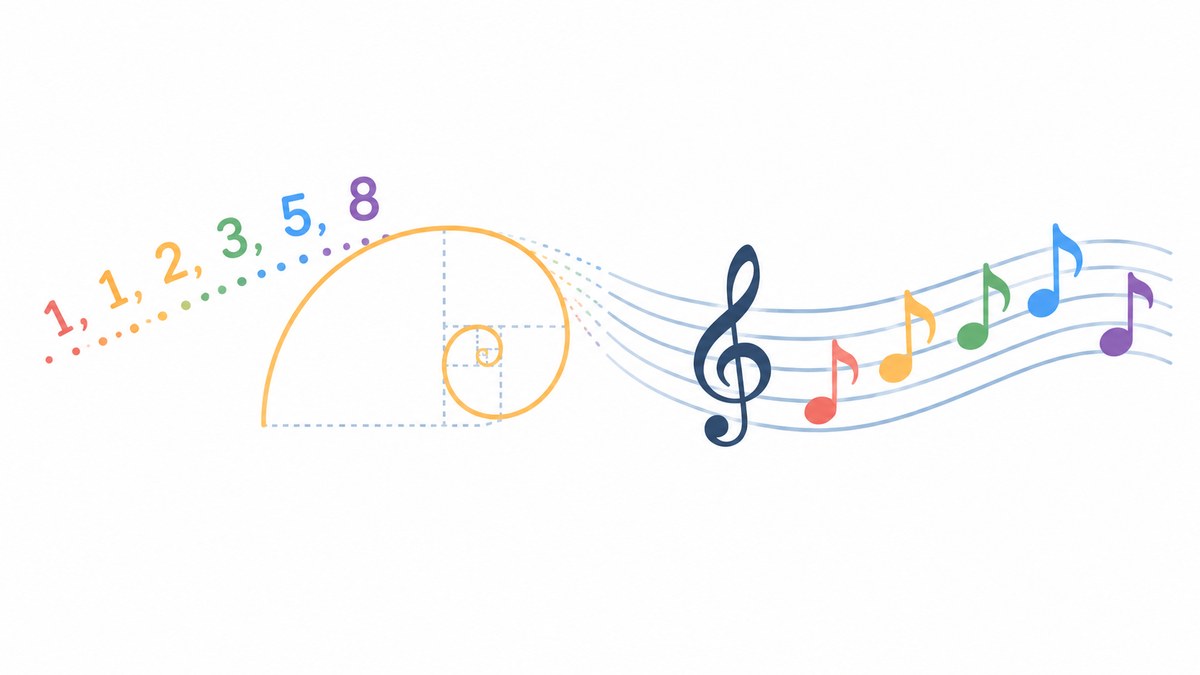
Researchers have also looked for mathematical patterns in his compositions. One famous example is the Fibonacci sequence, named after the Italian mathematician Fibonacci. In this pattern, each new number is made by adding the two numbers before it: 1, 1, 2, 3, 5, 8, 13 and so on. This Fibonacci sequence can be applied to the structure of songs.
Researcher Donald Maurice studied whether the Fibonacci sequence and the Golden Section, another mathematical pattern, could help explain the structure of his Viola Concerto. But finding a pattern does not always mean the composer planned it that way. Sometimes researchers use mathematics to find interesting shapes and relationships in music after it has already been written.
Olivier Messiaen: Patterns in Rhythm
Olivier Messiaen (1908 to 1992, France) was a composer, teacher, and organist. He played the organ for many years and wrote important music for the instrument.
Messiaen was especially interested in unusual rhythms and repeating patterns. Researcher Julian Hook studied rhythms in Messiaen’s Turangalîla-Symphonie and showed that mathematics could help explain how some of those rhythms were organized.
For example, a rhythm might repeat, become longer, return in a changed form, or follow a pattern.
This does not mean Messiaen was simply solving equations while composing. Instead, mathematics gives us another way to understand the patterns in his music.
Iannis Xenakis: Using Chance
Iannis Xenakis (1922 to 2001, Greece and France) was a composer who also worked as an engineer and architect. His background helped him connect mathematics, design, and music. He used probability, or the mathematics of chance, to help organize sounds.
One famous example is his composition Achorripsis. Researcher Edward Childs later studied this piece and showed how Xenakis used probability to organize different parts of the music.
A simple way to understand probability is to think about rain. You may not know exactly when every raindrop will fall, but you can describe whether the rain is light, heavy, or spread out.
Xenakis used probability in a similar way to organize musical events. Math helped create the structure, but Xenakis still decided how the final piece should sound.
Tom Johnson: Letting a Rule Build a Melody
Tom Johnson (1939 to 2024, United States) was a composer and writer about music. He became especially interested in using simple rules, numbers, and patterns in composition.
For example, imagine this rule:
Move up two notes.
Move down one note.
Repeat.
If you keep following the rule, the rule begins to help build the melody.
Johnson explored ideas like repeating patterns and self similarity, where the same kind of pattern appears again and again.
The rule helps choose the notes, but the composer still decides which rule to use and what to do with the result.
Eugenia Cheng: Mathematics and Music Together
Eugenia Cheng (born 1976, United Kingdom and United States) is a mathematician, concert pianist, composer, and educator. She studies category theory, a branch of mathematics that looks at patterns and relationships.
Music is also an important part of her life. Cheng is a pianist and composer, and her music has been written for professional performers.
She also teaches a course called The Mathematical Secrets of Music, where students explore connections between mathematics and music.
Cheng’s work shows that mathematics is not only something we can use to study music. It can also help musicians explore patterns, create ideas, and think about music in new ways.
Does Mathematics Make Music Less Creative?
Note that a composer still decides which rule to use, which notes to start with, what rhythm to use, which instruments should play, when the pattern should change, and when to break the rule.
Mathematics can give composers new ideas. The creativity comes from deciding what to do with those ideas.
Music theory uses mathematics to understand music. Understanding the theory behind music can foster more creativity instead of less creativity.
References
- Leibniz, G. W. (1712, April 17). Letter to Christian Goldbach. In L. Dutens (Ed.), Opera Omnia, Vol. 3, pp. 437 to 438.
- Bühler, W. (2019). Consonance Based Interval Systems and Their Matrices: Leibniz’s Harmonic Equations. Journal of Mathematics and Music, 13(1), 42 to 59.
- Schoenberg, A. (1975). Style and Idea: Selected Writings of Arnold Schoenberg. Faber & Faber.
- Xenakis, I. (1992). Formalized Music: Thought and Mathematics in Composition. Pendragon Press.
- Childs, E. (2002). Achorripsis: A Sonification of Probability Distributions. Proceedings of the International Conference on Auditory Display (ICAD), Kyoto, Japan.
- Hook, J. L. (1998). Rhythm in the Music of Messiaen: An Algebraic Study and an Application in the Turangalîla Symphony. Music Theory Spectrum, 20(1), 97 to 120.
- Maurice, D. (2004). Bartók’s Viola Concerto: The Remarkable Story of His Swansong. Oxford University Press.
- Johnson, T. (1996). Self-Similar Melodies. Editions 75.
- Cheng, E. (n.d.). About Eugenia. Eugenia Cheng official website.
- School of the Art Institute of Chicago. (n.d.). Eugenia Cheng. Faculty profile.
- The Royal Society. (2017). Beyond Infinity, Eugenia Cheng. Royal Society Science Book Prize.